
Testing the Trinity (Part 2 of 3)

In part 1 of this series, we considered several passages of Scripture that are inherently problematic for the doctrine of the Trinity. And as perplexing as these verses are vis-à-vis the Trinity, though, they are really just the “tip of the iceberg.” Because whereas the Trinity affirms that Jesus is divine by virtue of His identity with God the Son, i.e. the “second person of the Trinity,” the New Testament consistently indicates a much different relationship with the supposed “Godhead”:

At once the Spirit sent [Jesus] out into the desert.

Mark 1:12

Jesus returned to Galilee in the power of the Spirit.

Luke 4:14

At that time Jesus, full of joy through the Holy Spirit, said “I praise you, Father, Lord of heaven and earth.”

Luke 10:21

Jesus, full of the Holy Spirit, returned from the Jordan and was led by the Spirit in the desert.

Luke 4:1

So what’s the problem? Quite simply – per the Trinity – since Jesus is the incarnation of the “second person,” and since all of the persons of the Godhead must remain distinct entities that neither overlap nor mix, then these verses describe scenarios that violate and essentially contradict the Trinity.  In short, the doctrine of the Trinity does not allow for Jesus to be the incarnation of the Son and simultaneously filled with the Holy Spirit. It’s one…or the other, thus being “both” is out of the question.

Furthermore, there are other passages which ascribe actions to the Holy Spirit when we might logically expect them to be done directly by the Son Himself.  For instance, take Jesus’ statement which ascribes the driving out of demons to the “third person” rather than Himself, i.e. the “second person”:

But if it is by the Spirit of God that I drive out demons, then the kingdom of God has come upon you.

Matthew 12:28

Since Jesus is the incarnation of the “second person,” and since the Trinity affirms that the Son is co-equal to both Father and Spirit in every respect, then why does Jesus have to appeal to another member of the Godhead to drive out demons?  Even if you accept the Trinity’s “Division of Labor” clause (that each member of the Godhead willingly assumes a different “role” when it comes to effecting our salvation) it begs the bigger question of why Jesus’ actions and authority are always attributed to either the “third person” or “first person” of the supposed Godhead…never the “second.”

“I can do nothing on My own initiative. As I hear, I judge; and My judgment is just, because I do not seek My own will, but the will of Him who sent Me.”

John 5:30

Then there’s the passage from Hebrews that speaks of Jesus offering Himself through the “Spirit” rather than the “Son”:

For if the blood of goats and bulls and the ashes of a heifer sprinkling those who have been defiled sanctify for the cleansing of the flesh, how much more will the blood of Christ, who through the eternal Spirit offered Himself without blemish to God, cleanse your conscience from dead works to serve the living God?

Hebrews 9:13-14

Considering that the Trinity’s “Division of Labor” defense is based upon the notion that Father, Son, and Spirit each assume distinctive roles and responsibilities as they work collectively to enact our redemption, why does the author of Hebrews attribute Christ’s sacrifice to an act of the Spirit rather than the Son?  Isn’t the Son’s sacrifice the whole point?

And what of these passages which declare not only the reality of Jesus’ resurrection, but also glorify the One responsible:

Christ was raised from the dead through the glory of the Father, so we too might walk in newness of life.

Romans 6:4

Who was declared the Son of God with power by the resurrection from the dead, according to the Spirit of holiness, Jesus Christ our Lord,

Romans 1:4

For this reason the Father loves Me, because I lay down My life so that I may take it again. No one has taken it away from Me, but I lay it down on My own initiative. I have authority to lay it down, and I have authority to take it up again. This commandment I received from My Father.

John 10:17-18

But if the Spirit of Him who raised Jesus from the dead dwells in you, He who raised Christ Jesus from the dead will also give life to your mortal bodies through His Spirit who dwells in you.

Romans 8:11

Paul, an apostle (not sent from men nor through the agency of man, but through Jesus Christ and God the Father, who raised Him from the dead)

Galatians 1:1

So did the Father raise Jesus from the dead, or did Jesus – i.e. God the Son – do it Himself?  Was it actually the Holy Spirit?  Maybe it was a collective effort?  Or is Scripture telling us plainly that the “three persons” aren’t so distinct after all?  Indeed, Paul seemingly obliterates the Trinitarian separation between Father, Son, and Spirit in the way that he routinely refers to the members of the Godhead as if they were the same “person”:

However, you are not in the flesh but in the Spirit, if indeed the Spirit of God dwells in you. But if anyone does not have the Spirit of Christ, he does not belong to Him.

Romans 8:9

We could look at scores of similar passages, but the point is simply this: the Trinity cannot provide a satisfactory explanation for the confluence that is implied in these passages without simultaneously tripping over one of its own rules.  Its insistence upon multiple, distinct persons within God is its Achilles’ heel, because as soon as you attempt to reconcile all of the Trinity’s many rules and restrictions about relationships within the Godhead, the doctrine simply collapses under its own weight.  And while there is nothing that inherently precludes “tri-personness” as a potential way of conceptualizing God’s nature, the problem is that you can’t pick and choose which parts of the doctrine to apply in a given passage. Because due to the internal, logical construction of the doctrine itself, every part of the doctrine has to hold true in every verse…or none of it does.

So what’s the solution? The difficulties with these passages vanish if you assume that God is a single “person,” such that “Father, Son, and Holy Spirit” speaks not to multiple persons in a Godhead, but to God’s relationship with all human beings.  Indeed, whereas the riddle the church fathers were trying to solve was the manner in which a “three person” God relates to Himself, what if the relationship at the heart of “Father, Son, and Holy Spirit” is God’s relationship to mankind generally, through His unique relationship to one Man specifically?

This hypothesis probably seems a little too simplistic, but which relationship makes more intuitive sense: God’s relationship to mankind – which Scripture speaks to on virtually every page – or God’s three-way relationship to Himself which has no actual mention in Scripture?  If we are to truly let Scripture speak for itself, then given the prior verses which plainly declare Jesus’ connection with the Holy Spirit, His designation as “Son” speaks not to His union with the “second person” of some theoretical Godhead, but it attests to His unique relationship with God via His own Holy Spirit!  For as the only-begotten Son, Jesus was not just the first person to experience the indwelling of God’s Spirit, but He was the fullness of the Spirit dwelling in human flesh.

Furthermore, what is the essence of the Kingdom of God if not God reconciling those who were naturally alienated from Him?   Moses couldn’t do it.  David wasn’t up to the task, either. There wasn’t a prophet, priest, or king in all of Israel who was able to placate God’s wrath and thereby repair humanity’s fractured relationship with Him…and it was all by design.  Because as the saying goes, “if you want something done right…you have to do it yourself.”

God knew all along that there was only One way to redeem creation and thereby establish His Kingdom, which is why everything under the Old Covenant pointed forward to the mission, victory, and glory of His Son.  The solution to Creation’s curse was always in view, but God nevertheless had to let us discover that we are utterly incapable of saving ourselves…even with the assistance of His own Holy Spirit.  For just as with any stubborn child who insists upon their ability to “do it myself,” He had to make sure we understood that in spite of all of our strivings we remain hopelessly alienated and separated from Him on account of our willful, selfish hearts.

But now, on account of everything that Jesus has done, the hope which had previously been promised has finally become reality.  He has made peace with God on our behalf and freed us from the dominion of darkness, triumphing over the unholy spirit of this age which manifests itself as disobedience and rebellion against God.

And you were dead in your trespasses and sins, in which you formerly walked according to the course of this world, according to the prince of the power of the air, of the spirit that is now working in the sons of disobedience. Among them we too all formerly lived in the lusts of our flesh, indulging the desires of the flesh and of the mind, and were by nature children of wrath, even as the rest.

Ephesians 2:1-3

So whenever the New Testament refers to the work of the Holy Spirit, it testifies to the fact that a Holy God continues to build His Kingdom by calling us out of spiritual bondage and drawing us unto Himself.  His Spirit beckons to ours amidst the throng of unholy voices which clamor all around us, convicting the world of sin while seeking to awaken each of us to the glory and the majesty of His Son.  To all those who hear His voice, receive Him, and repent of their sin, God gives them the right to become His children on the basis of the price that Christ has already paid to redeem them.  They are born again as citizens of God’s Kingdom, indwelt by His Holy Spirit, and given new hearts that long to honor their Father and their Lord:

“This is the new covenant I will make with my people on that day, says the Lord: I will put my laws in their hearts, and I will write them on their minds.”

Hebrews 10:16 (NLT)

Clearly not everyone responds to the Spirit’s call, and all those who resist His Spirit and willingly harden their hearts are therefore utterly incapable of entering into His Kingdom.  Their rejection of His Spirit is likewise a repudiation of Christ, and whoever does not have the Son does not have the One who sent Him.  Thus by suppressing the Spirit of Truth they remain in spiritual darkness and under His condemnation as children of wrath:

For the wrath of God is revealed from heaven against all ungodliness and unrighteousness of men who suppress the truth in unrighteousness, because that which is known about God is evident within them; for God made it evident to them.  For since the creation of the world His invisible attributes, His eternal power and divine nature, have been clearly seen, being understood through what has been made, so that they are without excuse. For even though they knew God, they did not honor Him as God or give thanks, but they became futile in their speculations, and their foolish heart was darkened.

Romans 1:18-21

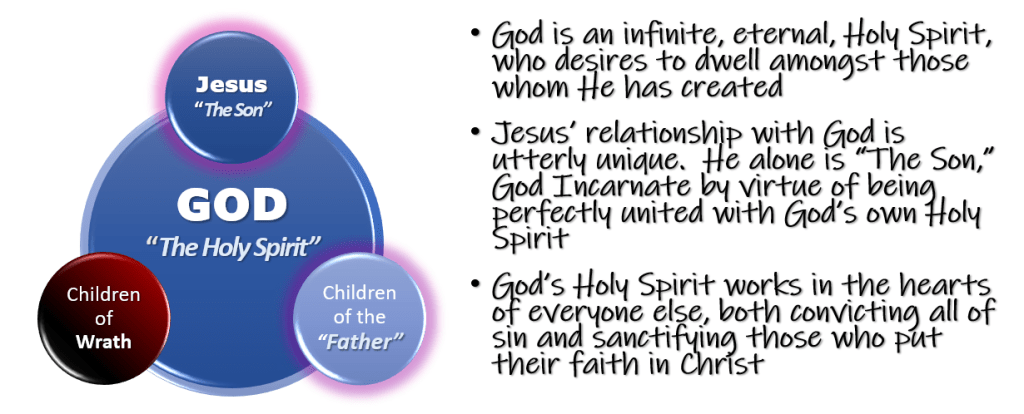
Here’s a model of how this works in practice:
Children 
of 
Wrath 
Jesus 
"The%d' 
GOD 
"The Holy Spirit" 
Children 
of the 
"Father" 
• God is an infinite, eternal, Holy Spirit, 
who desires to dwell amonost those 
whom He has created 
• Jesus' relationship with God is 
m+±erlH mniqme. He alone IS "The Son," 
God Incarnate by vir±me of beinq. 
perfectly united with God's own Holy 
Spirit 
• Qod's 4401% Spirit works in the hearts 
of everyone else, both convictino all of 
sin and sanctifyinq those who pmt 
their faith in Christ

Ultimately, then, “Father, Son, and Holy Spirit” serves first and foremost as a threefold doxology which reminds us of the love that God has for the world, a love that compelled Him to give His only Son in order to save it.  At the same time, it showcases the boundless love and compassion of Christ, the righteous One who gave His life for the unrighteous, and glorifies Him as our kinsman-redeemer, the only worthy intermediary between a Holy God and the one aspect of creation that has willfully rejected Him:

But God demonstrates His own love toward us, in that while we were yet sinners, Christ died for us.

Romans 5:8

For there is one God, and one mediator also between God and men, the man Christ Jesus.

1Timothy 2:5

Thus the point of “Father, Son, and Holy Spirit” isn’t to reveal “three persons in God” who manifest the essence of love by loving each other from all eternity; rather, it proclaims the great love that the Father has for all humanity…especially for His Son.  The point is not to differentiate between co-equal members of a Godhead, but to distinguish the subjects of the Kingdom from those who remain forever alienated from their Creator.  To separate those who are indwelt by His Spirit from those whom His Spirit only convicts.  To set apart God’s children from those who practice lawlessness.  To divide the sheep from the goats, to identify those who are “in Christ” versus those who are not, and most of all, to glorify the One who made it all possible, the Lord Jesus Christ, God’s only Son and chosen King. 

For God so loved the world, that He gave His only begotten Son, that whoever believes in Him shall not perish, but have eternal life. For God did not send the Son into the world to judge the world, but that the world might be saved through Him.

John 3:16-17

Granted, this is a lot to absorb, and in part 3 of this series we will take another look at some of these verses that confound the logic of the Trinity and see how well this alternative stands up.

Testing the Trinity (Part 1 of 3)

When I first started reading through the Gospels, I was shocked to discover how often Jesus clashed with the “religious” people of His day, particularly the scribes and the Pharisees. After all, if anyone in Israel should have “gotten it,” it should have been Israel’s religious leaders! Yet not only were most of them oblivious to the Son of God who literally stood right in front of them, they actually hated Him enough to kill Him…

The problem was that in their zeal to uphold the Law, they had piled on so many layers of extraneous rules and regulations that they lost sight of the One they were ostensibly trying to honor. The result was a manmade, artificial standard by which righteousness and orthodoxy were measured, and while the Pharisees were apparently held in high regard by the average Jew, Jesus was none too pleased with the false piety and sense of self-righteousness that their semblance of Judaism fostered:

Woe to you, scribes and Pharisees, hypocrites! For you tithe mint and dill and cummin, and have neglected the weightier provisions of the law: justice and mercy and faithfulness; but these are the things you should have done without neglecting the others. You blind guides, who strain out a gnat and swallow a camel!

Matthew 23:23-24

But woe to you, scribes and Pharisees, hypocrites, because you shut off the kingdom of heaven from people; for you do not enter in yourselves, nor do you allow those who are entering to go in.

Matthew 23:13

Without question, Jesus’ stern rebuke of those who prided themselves in their religion holds many lessons for us even today. In this post, though, I want to consider the principle which Jesus turned to whenever He was confronted with false teaching: He always debunked and refuted errant dogma by testing it against the entirety of God’s Word:

You are mistaken, not understanding the Scriptures nor the power of God.

Matthew 22:29

Jesus always put His adversaries in their place by citing Scripture (remember His temptation by Satan in the wilderness?) so I wonder how He would respond to those who have proclaimed Him to be the “second person in the Godhead.” For like the Pharisees, who had plenty of alleged Scriptural support for their own misguided extrapolations, Trinitarian stalwarts are able to muster an impressive array of Scriptures that apparently dovetail with and support the doctrine of the Trinity. Yet just as Jesus routinely revealed the flaws in the Pharisees’ teachings by citing a single verse to the contrary, so too could one verse effectively render the Trinity null and void. And as it turns out, it’s not all that difficult to find passages that are inherently problematic for the Trinity:

But of that day and hour no one knows, not even the angels of heaven, nor the Son, but the Father alone.

Matthew 24:36

How can there be things that the Father alone knows if the members of the Godhead are all co-equal?  The only answer that the Trinity can offer is to distinguish between Jesus’ human and divine natures.  Simply put, as the incarnation of the divine “second person of the Trinity,” Jesus is both “100% God” as well as “100% human.” As such, the Trinity posits that whereas the divine Son remains forever co-equal with the Father, in His humanity there were some things that Jesus did not ascertain…like the aforementioned knowledge of the end.

More often than not this distinction seems to resolve the tension; nevertheless, the stark way in which Jesus singles out the knowledge of the “Father alone” certainly creates an added layer of complexity in this passage.  For since there are clearly things the Father knows that “no one” else is privy to, and since the Trinity unequivocally affirms that the divine Son and Holy Spirit are distinct persons from the Father, are they therefore included in “no one”?  The standard Trinitarian response to this question is an emphatic “of course not!” but in the final analysis this retort sounds more like “because I said so!” than an actual explanation.

If this weren’t bad enough, the Trinity’s appeal to Jesus’ humanity in lieu of His deity completely falls apart in the face of verses that take things a step further:

You heard that I said to you, ‘I go away, and I will come to you.’ If you loved Me, you would have rejoiced because I go to the Father, for the Father is greater than I.

John 14:28

Here again, Trinitarians are quick to invoke the difference between Jesus’ human and divine natures.  In this case, though, if Jesus is truly referring just to His physical essence – which is really the only explanation that the Trinity can offer for the Father being greater than the Son – then the context of His entire statement immediately raises all kinds of thorny questions:

  • When Jesus says “I” go to the Father who is greater, if “I” is just His physical body, what becomes of His union with the “second person” when He leaves? 
  • How would it even be possible for Jesus to physically be with the Father apart from the “second person”?
  • Since the Trinity affirms that Jesus’ union with the “second person” is unbreakable – save for one moment on the Cross – then is it possible that Jesus is in fact referring to the divine “Son” being somehow lesser than the “Father”?

There are very few options in the Trinity’s bag of tricks that even begin to make sense of these questions, and once again, every answer inevitably leads to another dilemma. Indeed, to the extent that you attempt to exclude either Jesus’ humanity or the “second person” from this passage, I think you’ll find that you’ve got even bigger problems to deal with…

In the final analysis, the only real argument that the Trinity can propose is that within the space of a single sentence, Jesus simultaneously uses the pronoun “I” to refer to His entire being (which will go to be with the Father) as well as His human nature exclusively (which is the only part of His being that is subordinate to the Father).  I don’t know about you, but this “answer” strains all sense of logic and reason. 

And what about the bizarre warning that Jesus gives to the scribes and Pharisees when they accuse Him of driving out demons by the prince of demons rather than by the power of God?  In Mark’s account, Jesus concludes His rebuke with a stern warning against blaspheming the Holy Spirit.  The Gospel of Luke, though, records the warning with an added caveat:

And everyone who speaks a word against the Son of Man, it will be forgiven him; but he who blasphemes against the Holy Spirit, it will not be forgiven him.

Luke 12:10

Although the Trinitarian response is predictable, it doesn’t really help when you try to reconcile it with the parallel doctrine which declares that “Son of Man” is a messianic title which should not be interpreted merely as a reference to Jesus’ human nature.  For whereas “Son of Man” appears to emphasize Jesus’ humanity from a certain perspective, its allusion to the heavenly figure of Daniel’s vision ostensibly makes it every bit as integral to Jesus’ deity as the title “Son of God.”  That being the case, how is it possible to blaspheme the “second member” of the Godhead with apparent impunity, and yet the same statements leveled at the “third member” would be unforgiveable?  Which doctrine has gotten it wrong? 

These are just a few of the many passages that the Trinity struggles to explain, and even with all of its caveats and exceptions the answers are not forthcoming.  The problem is not the person of Jesus per se, but the need to preserve the full deity of a Son who is distinct from both Father and Spirit and yet simultaneously united with Christ.  And so even though this “triune” model may make sense in theory, it simply can’t stand up against the collective testimony of Scripture.

Again, consider Jesus’ rebuke of the Pharisees.  Even though the Pharisees started with what was true, the Law of Moses, in their strivings to keep and defend it actually ended up obscuring and even subverting it.  Their traditions, dictates, and dogmas progressively warped the very fabric of Judaism, resulting in an untenable system that compromised the essence of the Law even as it maintained an appearance of righteousness and propriety.

Does this sound vaguely familiar?

Like the Pharisees before them, as the early church sought to ensure the integrity of the apostolic faith and protect it from errant speculation, they constructed an extra-Biblical framework that endeavors to speak where Scripture is silent.  In the process, the Trinity became a law unto itself by virtue of the church’s repeated insistence that it was true; unfortunately, though, it also ended up usurping the very ideals and truths it was designed to protect.  In short, the Trinity simply fails the test. Because when you try to reconcile the Trinity with Scripture it does little to illuminate Christianity’s most mysterious and yet distinctive aspect – an incarnate God who died to redeem Creation – and frequently generates more questions than it answers.

So is there a better answer than the Trinity? Many alternatives have been proposed over the past 2,000 years, and most have fallen woefully short. Still, I believe that a better answer does exist, and in part 2 of this series, that’s exactly what we’ll try to discern.

What is the “Godhead”?

Whenever you talk about the Trinity, one concept that is bound to come up is referred to as the “Godhead.” And…surprise, surprise…here we find yet another “essential” aspect of Christian theology that cannot be found in the Bible. Now I’m sure that fans of the King James Version (among others) will be quick to protest, but the point is simply this: even though the word “Godhead” appears in many of our English translations of the Bible, the historic concept of a “Godhead” is both glaringly absent from and indeed contrary to Scripture.

To be clear, if you assume that “Godhead” is merely a synonym for “God’s nature” or “God’s essence,” then there’s nothing particularly objectionable about the term; that being said, the notion of a “Godhead” has historically meant something much different. The concept of a “Godhead” is central to religious systems that are based upon a belief in emanationism, which Encyclopedia Britannica defines as a “philosophical and theological theory that sees all of creation as an unwilled, necessary, and spontaneous outflow of contingent beings of descending perfection—from an infinite, undiminished, unchanged primary substance.”

In other words, emanationism asserts that everything from angels to rocks has come into existence by virtue of being generated from a single, divine source; moreover, the emanations closest to the source are the “most divine” (like angels) whereas physical objects are generated by the emanations furthest from the source and therefore are the “least divine” (like rocks). Not only that, but a fundamental tenet of emanationism is that everything in the universe has always existed since every being and each object emanated spontaneously and necessarily from this eternal source. And over the centuries this universal source has been alternatively referred to as the “Monad,” the “Father,” the “One”…or the “Godhead.”

Thus at its core, the whole idea of a “Godhead” is inherently antithetical to Judeo-Christian doctrine, which declares that God spoke the universe into existence out of nothing and because He chose to do so, not because His essence couldn’t help but generate things as it filled the universe. Indeed, the belief in a “Godhead” is more akin to pantheism and Eastern religions than it is to Judaism, Christianity, or Islam, and it lies at the heart of Gnostic philosophies which clashed with the Apostolic church and subsequently influenced the heretical ideas of Marcion and Valentinus in the 2nd century AD.

The notion of the “Godhead” found its fullest expression, though, towards the middle of the 3rd century AD when the philosopher Plotinus postulated the “One” as the source of everything. According to Plotinus, the “One” emanated everything that exists, with the highest order emanation being the “divine mind” and the lowest order emanation being matter itself. There is much more that can be said about Plotinus’ philosophy, but perhaps the most significant aspect of his ideas is their timing. The debate around the Trinity was soon to reach its zenith on account of the heretical teaching of Arius of Alexander, and the parallels between Arianism and Plotinus are indeed striking. Arius effectively refers to the “One” as “Father,” and to the “divine mind” as “the Son” or “the Logos.” And just as the “divine mind” is the most divine entity in the universe aside from the “One,” so too is the “Son” slightly less divine than the “Father” from which He was begotten…

Thus despite the fact that the historic concept of a “Godhead” is at odds with the Judeo-Christian belief that an eternally self-existent, divine Being (i.e. God) created the universe as an act of His own will and in accordance with His purpose and design, the early church appropriated this anti-Biblical concept as the basis for explaining the Trinity nonetheless. What’s more, it’s clear that this understanding of the “Godhead” would have been well-known by the church fathers, so why did they adopt it in the first place? Good question. There is perhaps a better question, though, that is much easier to answer: what about the apparent Scriptural support for the usage of the term “Godhead”? I say “apparent,” because depending upon the translation of the Bible that you prefer it would seem to establish the legitimacy of a “Godhead”:

“Forasmuch then as we are the offspring of God, we ought not to think that the Godhead [Theion – divine nature or divine essence] is like unto gold, or silver, or stone, graven by art and man’s device.”

Acts 17:29

“For the invisible things of him from the creation of the world are clearly seen, being understood by the things that are made, even his eternal power and Godhead [Theiotes – deity manifested, a revelation of God (His attributes) which reveals Himself for people to know] so that they are without excuse.”

Romans 1:20

“For in him dwelleth all the fulness of the Godhead [Theotetos – deity] bodily.”

Colossians 2:9

These verses from the KJV are the three places in the New Testament where “Godhead” is found, and while they might appear to substantiate the validity of the “Godhead” as a Scriptural concept, it is worth noting that many of the more literal translations of the New Testament (NIV, NASB, ASV, ESV) don’t use the word “Godhead” at all. That’s because the three Greek words translated above as “Godhead” are all different forms of the root word theos, the Greek word for God, which many translations choose to render more literally as “divine” or “deity” rather than “Godhead.” Hence the reason that the term “Godhead” remains an accepted part of Christian parlance and orthodoxy even today – in spite of its historical baggage – probably owes more to the linguistic preferences of the authors of the KJV than to any actual, Biblical theology. (For further details, see noted scholar and theologian, B. B. Warfield’s article on the origins and meaning of the term Godhead.)

So where does this leave us? Shouldn’t the history of the “Godhead” preclude it from being part of Christian thought and doctrine by definition? And wouldn’t its demise likewise nullify the Trinity itself? I’ll let you draw your own conclusions, but at a minimum, it certainly raises some additional red flags when you consider the dogmatic way in which the Trinity has been proclaimed and applied over the past two millennia. Because even though we may not think about “Godhead” today in light of its original context, the fact that the early church turned to this un-Biblical concept as a way to substantiate the Trinity – which itself cannot be explicitly found in Scripture – should make us stop and consider just how “essential” this whole doctrine really is.

Is God a Trinity?

Generally speaking, there are two parties involved in any legal dispute. The party who initiates the complaint is known as the plaintiff, whereas the defendant is the party who has allegedly wronged the plaintiff in some way. Moreover, since the plaintiff is asking the court to use the power of the state to force the defendant to address their grievances, the plaintiff is the one who is required to prove that their complaints against the defendant are legitimate. This principle is known as the “burden of proof,” and practically speaking this means that the defendant doesn’t have to “prove” their innocence in order to be exonerated. All the defendant has to do is demonstrate that the plaintiff has not sufficiently met the burden of proof that is required to substantiate their charges.

This concept underlies the notion that the defendant is “innocent until proven guilty,” but where things get complicated is in determining the “weight” of the plaintiff’s burden. Depending upon the nature and severity of the charges being brought before the court, the “standard of proof” which the plaintiff must attain can range from merely presenting “some credible evidence” in support of their claims, all the way up to making a case that leaves no plausible reason to believe the charges are not true. The latter is the standard of proof that must be met in criminal cases, and is referred to as proof “beyond a reasonable doubt.”

With this setting in mind, let’s consider the claim that God is in fact a Trinity, i.e. three persons existing within a singular godhead. The first thing we need to establish is who bears the burden of proof in the debate: is it those who claim that God is a Trinity, or those who say He is not? Because on one hand, if the Trinity is the “defendant,” then it would be presumed to be “innocent” of any charges that it is false; moreover, any claimants to the contrary would have to “prove” that the Trinity is indeed false. In other words, as the “defendant,” the Trinity would be assumed to be true until proven otherwise. If, on the other hand, the Trinity is actually the plaintiff, then the burden of proof would fall upon those who claim it to be true.

When you look at the history of this doctrine, the Church has certainly positioned the Trinity as the “defendant” for almost two millennia. Why do I say that? Because the Trinity has become the litmus test of orthodoxy, such that it’s veracity is never in question and anyone who dares to deny it is automatically assumed to be non-Christian by default. Hence any position that contradicts the Trinity is deemed to be heresy simply because it violates the Trinity…not necessarily because it conflicts with Scripture. This caveat is vital to grasp, since it is one thing to “have your case thrown out of court” because your claims are clearly contradicted by Scripture; it’s another thing to dismiss something as heretical just because “it’s not the Trinity.” And yet for most of the last 2,000 years, the latter condition has been the standard.

Despite the Trinity’s preferential “defendant” status, though, after almost 2,000 years of debating this doctrine its proponents have indeed assembled a mountain of circumstantial evidence to “prove” that it is true. Furthermore, they would argue that the case for the Trinity is so compelling that it demonstrates the validity of the doctrine beyond any reasonable doubt. In reality, though, it is technically not possible to “prove” the doctrine of the Trinity since the evidence for this perplexing doctrine is entirely circumstantial. In other words, since you can’t find direct, Scriptural evidence for this doctrine anywhere in the Bible, even though there is substantial “evidence” that corroborates the Trinity and apparently bolsters its legitimacy, it can never truly establish it as fact. Because just as circumstantial evidence is not considered sufficient to establish truth beyond a reasonable doubt in a court of law, neither is it adequate to prove the Trinity.

The problem is that circumstantial evidence is always subject to interpretation…and there is rarely a single valid perspective. That being the case, since Scripture never explicitly provides an exposition of the meaning of “Father, Son, and Holy Spirit,” every framework that attempts to explain it can only be viewed as a plaintiff in any debate – including the Trinity – because it necessarily bears the burden of proof. In short, whereas the Trinity is typically positioned as the “defendant” whenever its merits are questioned, in actuality the only defendant should always be Scripture.

In other words, while it’s one thing to exonerate the Trinity (or any doctrine) against alternative ideas that may…or may not…be true themselves; it’s quite another to withstand the scrutiny of actual Scripture. This is why one of the rallying cries of the reformers was “Sola Scriptura!” because they rejected extra-Biblical ideas and practices if they could be shown to be contradicted by Scripture. They rightly challenged mere tradition and decree as the basis for belief, and yet we continue to cling to this extra-Biblical doctrine whose only real defense is an appeal to tradition.

To be fair, the doctrine of the Trinity has served the Church well for almost 2,000 years, apparently vanquishing a host of heretical teachings and ideas which threatened to compromise the very essence of Christianity. So if nothing else, lacking a better alternative, it has clearly stood the test of time. Still, if the notion that God is a triune-being was clearly articulated in Scripture, then the history of this doctrine would have been much different. There would have been little point in arguing about it and spilling blood over it, since the “physical evidence” would have been both obvious and irrefutable. But since direct, Scriptural support doesn’t exist, we need to acknowledge that the Trinity is therefore just a possible explanation of “Father, Son, and Holy Spirit.”

Put differently, in lieu of Scriptural “hard evidence” that forthrightly and unambiguously declares the notion of “three persons in a Godhead” to be true, there is no basis for granting the Trinity “defendant” status when it is effectively just another plaintiff trying to make its case. Since the “smoking gun” does not exist, the highest status that the Trinity can hope to claim is therefore “plausibility,” which necessarily puts it on the same footing as every other potential explanation as to the meaning of “Father, Son, and Holy Spirit.”

Thus when you consider the significance and influence that the doctrine of the Trinity has been accorded when it comes to matters of faith and practice, we would be wise to evaluate it in the same manner that the Bereans tested Paul’s claims. They were commended as “noble” on account of their diligence and dedication when it came to searching the Scriptures in order to validate the truth of what Paul was teaching, so we should not be afraid to scrutinize and test this doctrine simply because it has been proclaimed as “truth” by the church for centuries. On the contrary, we should welcome each challenge as an opportunity to grow in our knowledge and understanding of our God as we eagerly seek to discover the truth. Because when it comes to the Trinity, not only does it collapse under its own weight when tested against the whole of Scripture, but there just may be a better answer

Choosing Your Church Home

I recently received an e-mail asking if I knew how to find a group of like-minded believers who do not adhere to the doctrine of the Trinity. This is a question that I too have wrestled with in the past, and the fact of the matter is that it isn’t all that difficult to find denominations and sects that reject the extra-Biblical doctrine of the Trinity. Just use your favorite search engine to look for “denominations that do not believe in the trinity” and you’ll find plenty of information.

The problem, of course, is that along with rejecting the Trinity, the alternatives typically come with a lot of their own non-Biblical baggage. As such, it does no good to exchange one error for a host of others, and I certainly would never advocate any faith-group over a traditional, Trinitarian-based fellowship simply because it rejects the Trinity. In fact, if you are currently part of a church that – except for the doctrine of the Trinity – is a vibrant, Biblically sound church, then by all means stay put! Alternatively, if you are in search of a home church where you can serve Christ and grow in your faith, don’t let the Trinity be an inhibitor or the deciding factor. It simply isn’t a deal-breaker.

This advice is probably not what you would expect me to offer, since I clearly find the doctrine of the Trinity to be exactly the kind of “high sounding nonsense” that Paul warns us about in Colossians 2:8 (NLT). That being said, it is also true that we are saved in spite of our theology…not because of it. Just to be clear, the point of this statement is not that we are free to believe whatever we want and still call ourselves Christian. Far from it! The point is that even though there are some non-negotiable things that we must believe in order to properly be called Christian, the Trinity simply isn’t one of them. Anyone who tells you differently is merely parroting the “company line,” so to speak, and so whenever someone tells you that in order to be a Christian you have to believe the Trinity, the best response is “please show me from the Bible why you believe this.” Needless to say, no one can show you where it says that you must believe that God is “three persons within a Godhead” in order to be saved…because it isn’t in the Bible!

Indeed, Paul is crystal clear when it comes to the grounds of our salvation. In his letter to the Romans, he proclaims that “if you confess with your mouth that ‘Jesus is Lord,’ and believe in your heart that God raised Him from the dead, you will be saved. For it is with your heart that you believe and are justified, and it is with your mouth that you confess and are saved.” (Romans 10:9-10) There is no mention of the word “Trinity,” neither is there anything about a “triune Godhead.” So if someone tries to tell you that you can’t be a Christian apart from believing in the Trinity, that’s tradition talking…not Scripture. Because in the final analysis, there is absolutely no Biblical basis for arriving at that conclusion.

Nevertheless, it is important to recognize that most of those who reject the Trinity are indeed pseudo-Christian or blatantly non-Christian. Mormons and Jehovah’s Witnesses are two examples that come to mind, but the problem isn’t the Trinity per se. After all, you can’t rightly be called “non Christian” because you reject something that isn’t in the Bible! The real problem, then, is that much of what these groups (and others) teach contradicts actual Scripture. That’s what really makes them non-Christian, and the fact that they also repudiate the Trinity is simply coincidental.

Thus when it comes to choosing a church that you can call “home,” the most important thing to look for isn’t a non-Trinitarian understanding of the relationship between Father, Son, and Spirit. For since the Trinity cannot legitimately be held up as the determining factor in anyone’s salvation, it is therefore a secondary matter by definition and should be treated just like differing viewpoints on eschatology, i.e. something that we can “agree to disagree” on. So if you encounter a church where this singular doctrine is treated like a “line in the sand,” then my advice would be to keep looking. If, on the other hand, you find yourself in a congregation that is both Biblically sound and willing to welcome you in spite of your reservations about the Trinity, then congratulations! You’ve probably found the right place. Just be prepared, though, because in lieu of accepting “three persons in the Godhead” as the way to understand Father, Son, and Holy Spirit, they’re likely going to want to know how you would explain it…instead. 🙂

The Legacy of Ravi Zacharias

Ravi Zacharias was a brilliant man who rarely…if ever…got bested in a debate. In spite of his profound intellect, though, he never came across as egotistical, condescending, or aloof. This combination made Ravi Zacharias an effective, passionate spokesman for his faith, a man who traveled the world proclaiming Christ and the hope that is found in Him alone. And yet, just like the rest of us, we are now reminded that Ravi Zacharias was also a sinner.

With the allegations regarding his pattern of sexual misconduct being recently confirmed by the ministry that bears his name, Ravi Zacharias’ behavior adds a troubling, saddening epilogue to an otherwise impeccable legacy that will now forever be remembered like Barry Bonds’ home run record or Lance Armstrong’s Tour de France dominance: tarnished. His tale becomes yet the latest example of a prominent Christian leader whose dramatic fall both shocks and appalls us, a jolting reminder that everyone needs accountability. It underscores the maxim that power in all of its many forms – whether political, economic, or spiritual – can be dangerously deceptive and self-destructive. And it is a sobering testimony to the fact that none of us is above temptation.

Certainly Scripture is clear on this point, and you need look no further than David’s affair with Bathsheba or Paul’s lament in Romans 7 to understand that it is utterly futile to place our hope in individuals, even someone like Ravi Zacharias. Because whenever we elevate someone and place them on a pedestal, we are effectively setting them up for a fall. We have taken our eyes off the One who truly deserves our reverence and transferred our confidence to the messenger, who quite frankly, will always disappoint us in the end.

Sadly, Ravi Zacharias is not able to answer for his actions and thereby make any kind of restitution to the women he took advantage of. I’d like to think that if he were here he would face the music by owning up to his behavior and stepping down; that he would publicly apologize and repent, without placing blame or trying to make excuses. Granted, this may be “wishful thinking” on my part since these are things he could have done while he was alive, but if we are brutally honest with ourselves we know that more often than not we do everything in our power to cover up and hide our sins, rather than willingly expose them. We are all like David who tried to hide from his sin until Nathan finally called him out…

Indeed, I trust that if he were still alive, Ravi would be actively seeking to heal the wounds which he has caused, even as he sought to exonerate the Lord whom his sin has cast a shadow upon. He would want everyone to know that his actions reflect solely upon himself and not upon his Savior. In short, he would use the reality of his sin to both deprecate himself and to exalt the glory of Christ, who sacrificed His own life precisely because none of us is above reproach.

Regardless, this episode will undoubtedly provide ammunition to many who will attempt to refute the claims of Christianity on the basis of one man’s transgressions. Just as David’s sin gave “great occasion to the enemies of the Lord to blaspheme” (2 Samuel 12:14, NKJV) so too will Christianity’s opponents seize upon the actions of one Christian as they try to discredit the Christ who had to die because of those actions…not to mention countless others. As such, it’s imperative that we take heed from Ravi’s fall, not from the standpoint of judgment, but one of reverent fear:

“If you think you are standing strong, be careful not to fall.  The temptations in your life are no different from what others experience. And God is faithful. He will not allow the temptation to be more than you can stand. When you are tempted, he will show you a way out so that you can endure.”

1 Corinthians 10:12-13

Thus in the final analysis, perhaps the most important take away from these sad revelations is not how quickly a reputation can be lost; but rather, “there but for the grace of God, go I.” For just as David’s sin brought severe repercussions upon all of his descendants, we need to remember that each sin of a believer – whether “big ones” like the fall of Ravi Zacharias, or our own, seemingly “small” failings – does untold damage to the Body of Christ. The world is watching all those who claim the name of Christ to see if there is any truth in what we profess, and it is therefore incumbent upon every believer to “walk the talk.”

Actions indeed speak louder than words, which is why everything we say and do should flow out of a heart that genuinely desires to honor, to serve, and to glorify our risen King. Our willingness to reach out and love others as ourselves is what draws people to Christ; nevertheless, whenever we fall short and miss the mark…as every messenger is destined to do eventually…we need to bring our failures into the light sooner rather than later, repent of them, and strive to make amends to those whom we have wronged. And just as important, once confession has been made it is the responsibility of the rest of us to forgive. This is the only way to keep small sins from festering and growing into the kind of scandal that – once again – has ruined the reputation…if not the testimony…of another Christian titan.

What, then, can we say about all of this? Words cannot adequately express the profound sense of disappointment and betrayal that so many are feeling right now; neither can they hope to truly atone for the damage that has been done in the lives of everyone at the epicenter of this tragedy. That being said, it’s important to unequivocally condemn the actions of a man who outwardly professed sexual purity, yet secretly objectivized and mistreated these women. Furthermore, while we may certainly lament the fall of this once-revered leader, our sympathy should lie with the victims, with his family, and with those who are now faced with cleaning up the mess that he has left behind. Because Ravi Zacharias has not only brought disrepute upon himself and his ministry, but in the eyes of many, upon Christ by association.

So regardless of how this whole situation eventually plays out, the one thing we can say with absolute certainty is that in spite of one man’s failings, the message of the Gospel will endure. Indeed, the very essence of the Good News is that our sins don’t have to define our destiny! For even though our guilt will justly condemn us for all eternity if we remain estranged and alienated from our heavenly Father, for all who are in Christ there is forgiveness, reconciliation, and eternal life. It’s a message of perfect hope that has been entrusted to imperfect individuals, a promise that is both magnified and exalted even by our worst transgressions…and even by those of Ravi Zacharias. A sinner like us, who has been saved by grace, through faith.

Is the Trinity Biblical?

When you ask most Christians if the Trinity is a Biblical doctrine, they instinctively answer in the affirmative. I say “instinctively” because most Christians will typically admit that they really don’t understand this enigmatic teaching. Nevertheless, they believe the Trinity to be trustworthy because if it wasn’t in the Bible, the Church wouldn’t present it as truth, right?

Don’t get me wrong, I honestly don’t believe that the Church has been intentionally trying to deceive or otherwise mislead people for almost two millennia, but the fact of the matter is that the word “Trinity” is not in the Bible. Not once. While this reality is perplexing, to be sure, the bigger issue is that the Trinity’s central premise – that God is one “being” or “essence” who exists in three distinct “persons” – is similarly nowhere to be found in the pages of Scripture. Not a single verse!

If you have any doubts about the veracity of these statements, you can read through the details in “A Synthetic Doctrine” of “Part 1: What is the Trinity?” And if you still are unconvinced, you can fairly easily prove them yourself by using your favorite on-line study Bible and a good search engine.

So where does this doctrine come from? I unpack this question in Part 2 of Testing the Trinity, but it is effectively the byproduct of the collision between Christian doctrine and Greek philosophy. Because as the Gospel spread across the Roman Empire, new believers struggled to reconcile their “Greek” beliefs with the proclamation of an Incarnate God. The Trinity was the result, a synthesis of two conflicting worldviews that essentially redefines God in light of ideas and concepts borrowed from Aristotle, Plato, and the Stoics.

What I find most astonishing, though, is that even the Trinity’s proponents will readily admit that the idea of “one God in three persons” was initially introduced by the “Greek Fathers” of the early church! Granted, this admission doesn’t necessarily rule out the Trinity as a possible explanation regarding the nature of God, and certainly the Trinity’s track record in the defense of Christianity is impossible to deny; still, that doesn’t change the fact that this teaching is extra-Biblical by definition! Indeed, when you consider all of the evidence, it certainly seems that the early church fell victim to the very “empty philosophies and high-sounding nonsense” that Paul warned us against in his letter to the Colossians. (Col. 2:8)

So is the Trinity historic? Absolutely. Is it backed by tradition? Without a doubt. But is it Biblical? The clear answer is “no.” It’s simply not there.

As such, why does this confusing doctrine continue to be touted as the arbiter of orthodoxy? Good question. And is there a better answer to the meaning of “Father, Son, and Holy Spirit” that itself steers clear of violating Scripture? Most would instinctively answer “no,” but I respectfully beg to differ…

Hot off the presses…

It’s official! “Testing the Trinity” is now available at Booklocker.com, Amazon, and other on-line outlets.

If you go to Booklocker.com, use the discount code “Save20” to receive a 20% discount.

And if you want to take a closer look you can either read Part 1 on-line or download it as a PDF file.

Either way, I’ve posted some instrumental arrangements of traditional Christmas favorites for you to listen to and download, if you want.