What is a Christian?

It has been said that “the Gospel is simple enough for a child to understand, but deep enough for you to spend the rest of your life studying it.”  I’m not certain where I first heard this notion, but I would argue that the same principle applies to answering the question, “What is a Christian?” That being the case, this is the simplest definition I can think of:

“A Christian is someone who does what Jesus would do, if Jesus were here.”

Remember those bracelets that posed the question “WWJD?”? They came pretty close to hitting the mark, but even if you can correctly answer “WWJD?” in each and every situation, knowing what Jesus would do and doing what Jesus would do are two different things.  In fact, it seems pretty clear that unless you actually follow through on the answer to “WWJD?” you’re still missing the point:

If you love me, keep my commands… Whoever has my commands and keeps them is the one who loves me. The one who loves me will be loved by my Father, and I too will love them and show myself to them.
John 14:15,21

If you keep my commands, you will remain in my love, just as I have kept my Father’s commands and remain in his love.
John 15:10

We know that we have come to know him if we obey his commands. The man who says, “I know him,” but does not do what He commands is a liar, and the truth is not in him. But if anyone obeys his word, God’s love is truly made complete in him. This is how we know we are in him: Whoever claims to live in him must walk as Jesus did.
1 John 2:3-6

In fact, this is love for God: to keep his commands. And his commands are not burdensome.
1 John 5:3

And perhaps most ominously…

Not everyone who says to me, ‘Lord, Lord,’ will enter the kingdom of heaven, but only the one who does the will of my Father who is in heaven. Many will say to me on that day, ‘Lord, Lord, did we not prophesy in your name, and in your name drive out demons and perform many miracles?’ Then I will tell them plainly, ‘I never knew you. Away from me, you evildoers!’
Matthew 7:21-23

Now just to be clear, you should not take these verses to imply that our standing in Christ is somehow contingent on our what we do…or what we don’t do.  That is not the Gospel!  The Good News is that God accepts us as His children in spite of our “performance” and not because of it!  Indeed, God isn’t “keeping score”, but He nonetheless expects His children to obey and serve Him consistently—albeit imperfectly—once we have accepted Christ and confessed our desperate need for His mercy and forgiveness:

Even as [Jesus] spoke, many put their faith in him. To the Jews who had believed him, Jesus said, “If you hold to my teaching, you are really my disciples.”
John 8:30-31

Therefore, let that abide in you which you heard from the beginning. If what you heard from the beginning abides in you, you also will abide in the Son and in the Father.
1 John 2:24 (NKJV)

With all these things in mind, dear brothers and sisters, stand firm and keep a strong grip on the teaching we passed on to you both in person and by letter.
2 Thessalonians 2:15 (NLT)

But now he has reconciled you by Christ’s physical body through death to present you holy in his sight, without blemish and free from accusation—if you continue in your faith, established and firm, not moved from the hope held out in the gospel. This is the gospel that you heard and that has been proclaimed to every creature under heaven, and of which I, Paul, have become a servant.
Colossians 1:21-23

Will we always obey perfectly?  Of course not.  Will we occasionally even resist Him?  More often than we probably care to admit.  But once again, God isn’t looking for faultless performance (which we can’t achieve in any case) as much as faithful persistence:

You will be hated by everyone because of me, but the one who stands firm to the end will be saved.
Matthew 10:22

For if we are faithful to the end, trusting God just as firmly as when we first believed, we will share in all that belongs to Christ.
Hebrews 3:14

“But my righteous one will live by faith.  And I take no pleasure in the one who shrinks back.” But we do not belong to those who shrink back and are destroyed, but to those who have faith and are saved.
Hebrews 10:38-39

I have fought the good fight, I have finished the race, I have kept the faith.
2 Timothy 4:7

In short, a true Christian isn’t someone who walks down to an altar, says a prayer, and then goes about their business.  It’s not even someone who can quote Scripture, or someone who faithfully attends church.  A true Christian is a disciple of Christ, someone who strives to do each and every day what Jesus would do, regardless of the cost.

Whoever wants to be my disciple must deny themselves, take up their cross daily, and follow me.
Luke 9:23

Once again, don’t be misled into thinking that our actions somehow earn God’s approval, His favor, or His love.  On the contrary!  The moment we receive Christ and become one of His adopted children, there is nothing we can do to either increase or decrease His love for us!  Thus the point of our actions is not about getting God to accept us, and it’s certainly not that we risk disqualifying ourselves whenever we stumble and fall; rather, the importance of our actions is that they reveal the true inclination of our hearts and the depth of our love for Him:

Jesus replied, “Anyone who loves me will obey my teaching. My Father will love them, and we will come to them and make our home with them.  Anyone who does not love me will not obey my teaching. These words you hear are not my own; they belong to the Father who sent me.
John 14:23-24

Because if we truly love Christ, if we genuinely desire to honor our Savior, then we will willingly submit ourselves to Him as our Lord:

If you declare with your mouth, “Jesus is Lord,” and believe in your heart that God raised him from the dead, you will be saved. For it is with your heart that you believe and are justified, and it is with your mouth that you profess your faith and are saved.
Romans 10:9-10

Granted, Paul is clear that our belief is what justifies us in God’s sight, but we need to understand that the Jewish concept of “belief” goes beyond mere mental assent to some abstract proposition.  For the Jews, our beliefs are inextricably linked to our behavior, such that if you say you believe one thing but then do something else, your actions betray your spoken belief.  Or as James puts it, your true beliefs—indeed, your faith—will be evident in the things that you do:

What good is it, my brothers and sisters, if someone claims to have faith but has no deeds? Can such faith save them? Suppose a brother or a sister is without clothes and daily food. If one of you says to them, “Go in peace; keep warm and well fed,” but does nothing about their physical needs, what good is it? In the same way, faith by itself, if it is not accompanied by action, is dead.

But someone will say, “You have faith; I have deeds.”

Show me your faith without deeds, and I will show you my faith by my deeds. You believe that there is one God. Good! Even the demons believe that—and shudder.

You foolish person, do you want evidence that faith without deeds is useless? Was not our father Abraham considered righteous for what he did when he offered his son Isaac on the altar? You see that his faith and his actions were working together, and his faith was made complete by what he did. And the scripture was fulfilled that says, “Abraham believed God, and it was credited to him as righteousness,” and he was called God’s friend. You see that a person is considered righteous by what they do and not by faith alone.

In the same way, was not even Rahab the prostitute considered righteous for what she did when she gave lodging to the spies and sent them off in a different direction? As the body without the spirit is dead, so faith without deeds is dead.
James 2:14-26

So is a Christian someone who claims the name of Jesus?  Yes!  Is a Christian someone who is trusting Christ to be their Savior?  Without question!  But as James warns us, actions really do speak louder than words. Calling Jesus “Lord” is nothing more than lip service if we withhold our hearts and our lives from Him, and if the testimony of our actions belie the affection we claim with our mouths, our fervent belief that Jesus is able to save sinners will be of little solace when we stand before Him at last:

By their fruit you will recognize them. Do people pick grapes from thornbushes, or figs from thistles?  Likewise, every good tree bears good fruit, but a bad tree bears bad fruit. A good tree cannot bear bad fruit, and a bad tree cannot bear good fruit. Every tree that does not bear good fruit is cut down and thrown into the fire. Thus, by their fruit you will recognize them.
Matthew 7:16-20

In short, Biblical faith is belief in action.  It’s work.  It requires effort and sacrifice.  Not so we might earn anything from God, but that we might offer something to Him.

For it is by grace you have been saved, through faith—and this is not from yourselves, it is the gift of God—not by works, so that no one can boast. For we are God’s handiwork, created in Christ Jesus to do good works, which God prepared in advance for us to do.
Ephesians 2:8-10

Therefore, my dear friends, as you have always obeyed—not only in my presence, but now much more in my absence—continue to work out your salvation with fear and trembling, for it is God who works in you to will and to act in order to fulfill his good purpose.
Philippians 2:12-13

Which effectively brings us back to where we started. What does it mean to be a Christian? Being a Christian means doing the things that Jesus would do if He were here. Not to earn God’s love, but to show our love for Him; not for our gain, but for His glory.

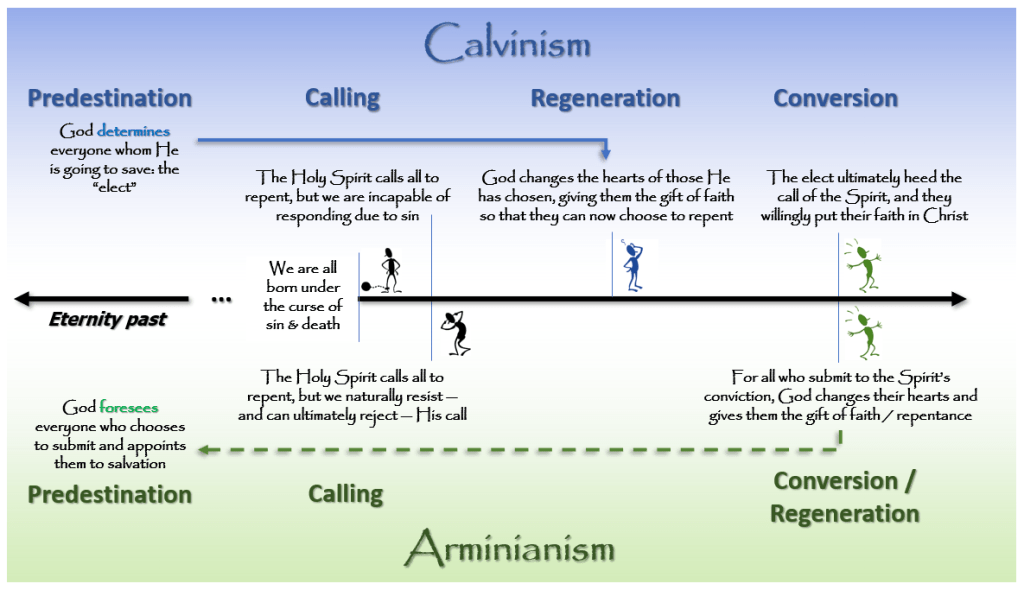
Predestination (Part 3) – Who Decides?

In Part 2 of this series, we considered the question of whether anyone is capable—prior to God supernaturally changing the disposition of their heart—of heeding the Holy Spirit’s call to repent and to receive Christ.  The two predominant schools of thought are Calvinism and Arminianism, and while both camps would agree that sin’s pervasive impact upon our hearts prevents us from naturally seeking after God, they differ in their understanding of those whom the Spirit supernaturally seeks out and draws to Christ.

Calvinists believe that predestination / election is entirely a function of God’s choosing, such that His “saving grace” is extended only to those whom He intends to save.  Those whom God chooses to save are known as the “elect”, and all of the “elect” are ultimately saved by virtue of God giving them new hearts.  They are spiritually “born again” and given the gift of faith, which opens their eyes to the beauty of Christ and compels them to joyfully embrace Him as Savior and Lord.

Arminians, on the other hand, believe that the work of the Holy Spirit is meant to open everyone’s eyes to both the magnitude of their sin, as well as the incomparable majesty of the Son who died to redeem them:

When [the Counselor] comes, he will convict the world of guilt in regard to sin and righteousness and judgment: in regard to sin, because people do not believe in me; in regard to righteousness, because I am going to the Father, where you can see me no longer; and in regard to judgment, because the prince of this world now stands condemned.
John 16:8-11 (NIV)

Accordingly, our eternal destination is ultimately determined by our decision to capitulate to the conviction of the Spirit…or not.  As such, predestination effectively becomes a byproduct of God’s omniscience, since He knows who will respond to the Spirit’s call and ordains (predestines) them unto salvation…rather than judgment.

Just to be clear, Calvinists also affirm that our willing choice to receive Christ is what confirms our status as one of the “elect”.  The difference is that until God intervenes and regenerates our hearts, Calvinists contend that we can respond to the overtures of the Holy Spirit with nothing but contempt (see Part 2)…regardless of how much grace God shows us prior to regeneration.   Our hearts and wills are so intrinsically hostile to God that He must first give us the ability to desire something other than our sin, at which point we become able to freely choose Him. 

So when it comes to understanding the doctrine of predestination and how it relates to the doctrine of salvation, it’s helpful to think about both doctrines in the context of an overarching process that has four main steps:

Calvinists:
  • Predestination: God chooses / predestines all those whom He intends to save, i.e. “the elect.”  This happened in eternity past, before the world was even created.
  • Calling: God convicts all of sin and calls us to repent (per John 16), but only the elect are eventually “drawn” to Christ (per John 6)
  • Regeneration: This is what we refer to as “spiritual rebirth” or being “born again”, whereby God regenerates / changes the hearts of the elect, which means:
    • Their eyes are opened to the majesty of Christ
    • They now have the ability to respond in faith to the Holy Spirit (per Ephesians 2:8-9)
  • Conversion: They surrender to God of their own free choice and put their faith in Christ, at which point their standing as one of the “elect” is confirmed
Arminians:
  • Predestination: God knows all things, including fore-knowledge of all who will choose to receive Christ, i.e. “the elect”, and He predestines them for salvation instead of judgment.  This appointment also happened in eternity past, before the world was even created.
  • Calling: God “draws” all people to Christ (per John 6) by convicting the world of sin, showing them the majesty of His Son, and calling all to repent.  (per John 16)
  • Conversion: While many continue to reject the Spirit, some willingly surrender to the conviction of the Holy Spirit and throw themselves upon the mercy of God.  It is at this point that their standing as one of the “elect” is confirmed.
  • Regeneration: This is what we refer to as “spiritual rebirth” or being “born again”, whereby God regenerates / changes the hearts of the elect and gives them the gift of faith (per Ephesians 2:8-9)

From a practical standpoint, the crucial difference between Calvinism and Arminianism is that Arminians view Conversion & Regeneration like two sides of the same coin.  They are inseparable events, unlike Calvinism, which allows for a time of indecision / continued resistance between receiving the God-given ability to respond in faith (Regeneration) and the actual exercise of that faith (Conversion).  This separation is an essential aspect of Calvinist theology, because apart from separating the receipt of faith (which is a result of God’s action) from a person’s decision to act upon that faith (which they freely choose to do once they have it) there would be no place for free will in the process.

Conversely, the area where Calvinists and Arminians are in complete agreement is that everyone who refuses to yield to the Spirit’s call will suffer eternal condemnation as the consequence for their intransigence.  This seems almost counter-intuitive to the entire message of the Gospel, that Jesus died to pay for our sin, so why is this particular sin deemed by God to be…unforgivable?  Because when the Holy Spirit convicts you of your sin and you choose to argue with or otherwise ignore Him, you’re basically calling God a liar:

“I tell you the truth, all sin and blasphemy can be forgiven, but anyone who blasphemes the Holy Spirit will never be forgiven. This is a sin with eternal consequences.”
Mark 3:28-29

In the final analysis, though, the primary point of contention is Calvinism’s assertion that for all those who ultimately suffer God’s eternal wrath, conversion was never even a possibility.  It’s a simple matter of cause and effect, because unless God chooses to change someone’s heart, they will never receive the gift of faith that enables them to follow Christ.  Consequently, apart from receiving the gift of faith (per Ephesians 2:8-9) a person is destined / doomed to remain beholden to their sin, which thereby subjects them to its curse and to eternal judgment.

This singular tenet of Calvin’s theology is what makes Calvinism so contentious, since it seemingly obliterates any notion of free will: first for the “elect”, who are effectively powerless to resist God’s saving grace, but more so for the condemned who are unable to choose anything other than their “default setting.”  Because if the condemned are truly incapable of choosing between two options, do they really have a choice?  And if they don’t have a choice, then how can they be held responsible for a decision they weren’t able to make in the first place?  How is that “fair”?  Or loving?

Calvinists counter that since God’s wrath against sinners is clearly justified, He would not be unfair / unjust if He never chose to save anyone.  That being the case, the fact that God chooses to ransom anyone from certain judgment is a clear demonstration of His mercy and His grace, which necessarily flow out of His love for us.  Therefore, since we also know that God is perfectly good, loving, and holy, we know we can trust Him and should rejoice in His decision…rather than disparage it.

While these affirmations are indeed Scriptural, and their argument is not illogical, that’s not the same thing as proving that their conclusion is incontrovertible. Furthermore, even though these statements about God’s justice, mercy, grace, and love are eminently true, Calvin’s conclusion nonetheless begs the bigger question: how does God decide whom He is going to save?  Or to put it differently, what can we do to make sure that God chooses us? This is where Calvinism tends to completely lose people, because Calvin’s answer is as blunt as it is disheartening: “you can do nothing.”  

Calvinists not only decry the Arminian belief that we retain the ability to submit to the conviction of the Spirit, but they also declare that a person’s standing as a member of the “elect” is not predicated upon anything they do…or don’t do.  Our actions, either positive or negative, are of no practical consequence in God’s decision making process: He is God, He is sovereign, and since He is holy and perfect, He relies upon nothing outside of His own will and counsel to decide whom He will ultimately redeem from certain judgment through His sovereign act of regeneration.  In short, someone’s status as one of those predestined unto salvation is completely due to the actions of a loving, sovereign God who has decided to change their heart and open their eyes.  It’s all for His glory and in accordance with His choice, which means that He gets all the credit for those whom He decides to save…and likewise takes none of the blame for those whom He chooses to leave to their fate. 

It’s a hard teaching, to be sure, and it drives many into the Arminian camp simply because they can’t stomach this aspect of Calvinism; however, it really doesn’t matter if we like this doctrine or not.  The only question that really matters is whether this central affirmation of Calvinism is actually true.  After all, the Bible teaches a lot of things that tend to rub people the wrong way, but our feelings about a particular teaching are irrelevant if it is indeed Scriptural.   And once again, Calvinists turn to the book of Romans and call upon Paul as their primary witness:

When Isaac married Rebekah, she gave birth to twins. But before they were born, before they had done anything good or bad, she received a message from God. (This message shows that God chooses people according to his own purposes; he calls people, but not according to their good or bad works.) She was told, “Your older son will serve your younger son.” In the words of the Scriptures, “I loved Jacob, but I rejected Esau.”

Are we saying, then, that God was unfair? Of course not! For God said to Moses, “I will show mercy to anyone I choose,  and I will show compassion to anyone I choose.” So it is God who decides to show mercy. We can neither choose it nor work for it.
Romans 9:10-16

Unpacking this passage warrants a blog post all on its own; but for now, suffice it to say that this is the point where most Calvinists simply rest their case.  And why not?  They paint a pretty convincing picture:

  • There are none who seek after God.  (Romans 3:10-12)
  • Unless God draws / drags us to Christ, none would come to Him willingly.  (John 6:44)
  • Not only that, but even our faith is a gift from God! (Ephesians 2:8-9)
  • Finally, we see that God reserves the right to do as He pleases, even when it comes to extending mercy and compassion. (Romans 9:10-16)

Conclusion: God chooses all of the “elect” and acts to ensure their salvation.

Indeed, when you put all the pieces together, the conclusion seems virtually inescapable: we are saved because God willed to save us.  We don’t choose Him; rather, He chose us from all eternity and purposed to change our hearts in accordance with His divine will. Not because we deserved it or because we asked for it, but in order that His only begotten Son would receive the inheritance that His Father has promised Him:

Only ask, and I will give you the nations as your inheritance, the whole earth as your possession.
Psalm 2:8

For those whom He foreknew He also predestined to be conformed to the image of his Son, in order that He might be the firstborn among many brothers. And those whom He predestined He also called, and those whom He called He also justified, and those whom He justified He also glorified.
Romans 8:29-30

Those the Father has given me will come to me, and I will never reject them. For I have come down from heaven to do the will of God who sent me, not to do my own will.  And this is the will of God, that I should not lose even one of all those he has given me, but that I should raise them up at the last day.  For it is my Father’s will that all who see his Son and believe in him should have eternal life. I will raise them up at the last day.”
John 6:37-40

And yet, there are verses like John 3:16 and 2 Peter 3:9 which would appear to contradict—and therefore invalidate—Calvin’s conclusion.  Because if it is in God’s power to save everyone (which of course, it is) and if God isn’t willing that anyone would perish (which is also true) then why doesn’t He simply regenerate everyone?

The Lord is not slow in keeping his promise, as some understand slowness. Instead he is patient with you, not wanting anyone to perish, but everyone to come to repentance.
2 Peter 3:9

Calvinists are quick to respond that what Peter actually means is that God isn’t willing that any of the elect would perish.  This is a logical and self-evident statement which happens to be true regardless of how you define “elect”, but there’s nothing in the text that requires us to make this assumption.  Moreover, since Peter explicitly refers to the “elect” at other places in his epistles when he wants to make a distinction, it seems odd to suggest that he wouldn’t have similarly done so in this particular passage.

Upon pointing this out, Calvinists typically invoke the difference between God’s prescriptive will, which always comes to pass, versus His permissive will, which allows for things to happen that are actually outside of His perfect will for us…like when He allows us to sin, for example.  In short, since we know that not everyone is saved, Calvinists deduce that this statement from Peter must therefore be teaching us something about God’s permissive will rather than His prescriptive will.  And since they believe His prescriptive will is what governs who is actually saved, their theology remains in tact.

Fair enough, but doesn’t it stand to reason that if God truly desired everyone to be saved, He would simply predestine…everyone?  Put differently, why doesn’t a loving God choose to predestine / elect everyone so that no one would ever perish?  Why leave anyone out?  What would be the point of not predestining someone?  These are the kind of questions which have fueled the debate between Calvinists and Arminians for centuries, and the inability to answer them definitively either way is why we’re still talking about them some 500 years after Calvin first put his ideas on paper. 

So in light of this apparent impasse, is it even possible to get to the bottom of what predestination is all about?  The short answer is “yes”, and the key to finally unpacking this doctrine is actually quite simple: we have to set aside the broken lenses and attendant baggage which have inadvertently been passed down to us over the years.  We’ll start that process next time, as we expose the most fundamental flaw in our assumptions about predestination, namely what predestination is really all about.  Because while everyone tacitly assumes that predestination is primarily concerned with explaining how some get to spend eternity in Heaven while others end up in hell, where you “end up”—your eternal “destination”—isn’t really the point.

If you don’t believe this, just use your favorite Bible search tool and look for the word “predestination”.  It’s not in the Bible.  The words that are in the Bible (depending upon the translation you use) are “predestined”, “foreordained”, or “chosen in advance”.  This distinction may seem like nothing more than a meaningless technicality, but it is foundational to a proper understanding of what it means to be “predestined”.  Because ultimately, being predestined has a lot more to do with our “journey”, than it does with our eternal “destination”.

Predestination (Part 2) – Are We Able?

Read Part 1 – Overview

There is a wealth of information available on the topic of predestination, and so rather than try to re-hash everything as part of this series, I would encourage you to do your own investigation into the perspectives on this contentious doctrine.  That way, as we grapple with the thorny issues and questions about predestination which invariably result, you’ll be able to tell if I’m somehow distorting a particular point of view…not to mention Scripture.  For while it’s certainly not my intention to misrepresent information for the sake of making a point, I also know that iron sharpens iron.  And so my hope is that we—like the Bereans—are more interested in pursuing the truth about predestination, versus simply “having an answer”.

Accordingly, in this post we are going to focus on the singular issue that ultimately divides Calvinists and Arminians: our ability (or lack thereof) to repent and turn to Christ.  Because when you sift through all of the verses, arguments, and assumptions that underlie both positions, the pivotal question is simply this: as those who are born under Adam’s curse, are we capable of seeing our need for Christ and subsequently confessing a desire to be saved from certain judgment?

The Calvinist response to this question is an emphatic “no”, which is why they contend that before we are able to repent and embrace Christ, God must change our hearts…first.  Put differently, the grip of sin upon our hearts, minds, and wills has rendered us utterly incapable of desiring to receive salvation and responding to God in faith, at least not without His express intervention.  Our hearts have become so hardened, and our hatred for God runs so deep, that we would rather perish in our sin than even think about turning from it:

Indeed, in their case the prophecy of Isaiah is fulfilled that says:

‘You will indeed hear but never understand, and you will indeed see but never perceive.  For this people’s heart has grown dull, and with their ears they can barely hear, and their eyes they have closed, lest they should see with their eyes, and hear with their ears, and understand with their heart, and turn, and I would heal them.’

Matthew 13:14-15

This assertion tends to shock / offend most people…at least initially…but if we are being honest it is hard to deny how intransigent our hearts naturally are.  Don’t we all look for ways to justify our behavior? Haven’t we all pursued our own agendas while minimizing the impact of our choices upon those around us?  It’s our nature to be self-centered and stubborn, and the last thing we want is anyone—especially God—calling us out.  And quite frankly, not only does our own experience testify to the depth of our sin, but Scripture is also replete with verses that collectively speak to our inherent inability to bring ourselves before God and repent in faith:

As it is written: “There is no one righteous, not even one; there is no one who understands; there is no one who seeks God. All have turned away, they have together become worthless; there is no one who does good, not even one.”

Romans 3:10-12

For no one can come to me unless the Father who sent me draws them to me.

John 6:44

For it is by grace you have been saved, through faith—and this is not from yourselves, it is the gift of God—not by works, so that no one can boast.

Ephesians 2:8-9

For all have sinned and fall short of the glory of God, and all are justified freely by his grace through the redemption that came by Christ Jesus.

Romans 3:23-24

These verses, and others like them, seem to paint a pretty stark picture: apart from God taking the initiative to rescue anyone, we would all naturally remain in a state of rebellion against Him and under His righteous wrath.  After all, these passages don’t tell us that “some are righteous,” that “some seek God,” or that “some can come to Christ of their own accord.”  To the contrary,all have sinned and fall short of the glory of God” such that “no one is righteous.” They declare there is “no one who seeks God,” there is “no one who does good, not even one,” and as Paul tells us in Ephesians, even our faith is a gift from God! 

This being the case, how can we manage to bring ourselves to God in repentant faith before He first condescends to give us that faith?  It’s logically impossible, which is why Calvinists deny the Arminian assertion that God predestines all those who willingly come before Him and throw themselves upon the mercy of Christ. We simply will never choose to do it of our own accord! Indeed, why else would Jesus proclaim that “no one can come to Him unless the Father draws them to Him”…first?

Simply put, Calvinists insist that our hearts and wills are so fundamentally corrupted by sin that we are incapable of even feeling remorse for our actions, let alone bending our knees to Christ as Lord and Savior.  Moreover, as any Calvinist will surely tell you, the Greek word translated as “draws” in John 6:44 is the same word used to describe someone “drawing” water up from the bottom of a well.  The water is not capable of contributing anything to the process, and it is only on account of the person who is “drawing” that the water moves at all.  In fact, the same word can also be used to describe “dragging” someone against their will!  Hence Calvinists categorically reject any notion of salvation that depends upon our ability to respond positively to the Gospel…prior to regeneration.

So what’s the Arminian response to all this?  In a nutshell, Arminianism contends that God pours out His grace upon all people as He draws them to Christ, and that ultimately we bear the responsibility for accepting or rejecting the overtures of the Holy Spirit as God convicts us of sin and calls us to repent.  They concur with Calvinists that apart from God drawing us to Christ, no one would ever repent; where they differ is in the scope of those whom the Holy Spirit actually draws.  Because whereas Calvinists believe that God draws only those whom He has predestined to save (i.e. the “elect”) Arminians believe that salvation is available to all:

For God so loved the world, that He gave his only Son, that whoever believes in Him should not perish but have eternal life.

John 3:16

The Lord is not slow in keeping his promise, as some understand slowness. Instead he is patient with you, not wanting anyone to perish, but everyone to come to repentance.

2 Peter 3:9

In other words, Arminians believe that not only does God’s grace demand a response, but that we retain the ability to make a choice either way…in spite of sin’s pernicious impact upon our hearts and wills.  As C.S. Lewis put it in “The Great Divorce”:

There are only two kinds of people in the end: those who say to God, “Thy will be done,” and those to whom God says, in the end, “Thy will be done.” All that are in Hell, choose it. Without that self-choice there could be no Hell. No soul that seriously and constantly desires joy will ever miss it. Those who seek find. Those who knock it is opened.

Methodists refer to this grace which draws us to Christ as God’s “prevenient grace,” but Calvinists are quick to recant the “no ones” listed above as proof that no matter how much grace God pours out upon sinners, we simply aren’t capable of responding to it positively.  Rather, they acknowledge God’s “common grace” that benefits all people—redeemed or otherwise—while rejecting the notion that sinners will ever act upon that grace in a way that leads someone to submit to Christ.   Calvinists maintain that unless God changes our hearts and gives us the faith to come to Christ, per Ephesians 2:8-9, no one will respond to the Holy Spirit with anything but contempt.

And what about John 6:44?  Doesn’t the fact that no one can come to Christ unless the Father first draws them (or drags them!) settle the debate?  Calvinists would certainly assert that it does, but the verse doesn’t actually say that God draws only those whom He has sovereignly predestined / chosen to regenerate.  Accordingly, while declaring that God draws only those whom He intends to save (i.e. the “elect”) is a possible interpretation of this passage, there’s actually nothing to preclude the Arminian notion that God potentially draws everyone—since as Peter already told us, God wants everyone to come to repentance—and that in the final analysis those who ultimately respond in repentance are actually saved.

Thus the lines are pretty clearly drawn, and it would appear that we have something of a stalemate.  But we’re just getting started, and next time we’ll look at how the doctrine of God’s sovereignty plays into the equation. 

Predestination (Part 1)

When you consider the vast array of Christian denominations that have come into existence over the past 400 years, one thing becomes clear: just about any issue can be perceived as sufficient justification for creating yet another faction within the Church. Every doctrine is a potential source of discord, and rather than clinging to the essential truths of our faith that should unite us, all too often we have allowed nuance to divide us. That being said, there are clearly some doctrinal matters where the issues at stake are fundamental, transcending both subtlety and opinion. And of all the doctrines that separate us, predestination is arguably the most controversial and divisive of all.

Two views of predestination have historically been offered, the first associated most closely with the teachings of John Calvin in the 1500s, and the other with those of Jacobus Arminius, a monk whose ideas subsequently repudiated those of Calvin. Referred to as “Calvinism” and “Arminianism” respectively, they differ on the basic question of how someone comes to be “saved”. For although both would agree that you cannot be “saved” apart from God’s work of regeneration (whereby He changes your heart and you are “born again”), the question is whether or not our choices have any part to play in this process. Arminians would say “yes!”, while Calvinists say “absolutely not!”

Essentially, the Calvinist stance on salvation is that all those who come to saving faith in Jesus Christ do so because God has chosen to supernaturally change their hearts, at which point their eyes are opened to His majesty and they willingly embrace the Lord and Savior whom they previously held only in contempt. Arminians, on the other hand, contend that God supernaturally changes a person’s heart at the moment they admit their need for Christ…and not before. In short, Calvinists believe that regeneration precedes faith, whereas Arminians believe that regeneration is what happens once someone acknowledges their need for Christ. For Calvinists, regeneration happens because of God’s choice…and no one else’s, while Arminians maintain that being “born again” is what happens at the moment we choose to fall upon Christ as our Savior and Lord.

So with regards to the doctrine of predestination, also known as election, the Calvinist position is that since our sovereign God chooses those whom He intends to save, He is the one responsible for predestining all who will be saved. The point is that God decides whom He is going to save – apart from anything that we do or decide – moreover, not all are chosen. Regeneration happens by God’s choice…and His alone…and since we all stand before Him as condemned sinners who deserve only judgment, the fact that He chooses to regenerate anyone (a.k.a. “save” them) is a demonstration of His mercy and His grace.

Alternatively, the Arminian understanding of predestination focuses on the fact that since God is all-knowing, He has known from all eternity those of us who will cry out to Him to be saved.  As such, these are the ones whom God has predestined to regenerate and save. This is commonly referred to as the “foreknowledge” or “prescient” view of election, whereby our status as one of the “elect” comes down to our choice to embrace Christ…or not.

If you’ve never wrestled with this doctrine before, you can probably see why this question of predestination / election is so contentious. On the other hand, if you have spent any time considering the question of election, chances are good that you are already firmly entrenched on one side or the other of this debate. Regardless of where you stand, though, I am persuaded that Calvinists and Arminians alike have essentially missed the point when it comes to this perplexing, enigmatic doctrine. There is a better answer to what predestination / election is really all about, one that neither destroys the doctrine of human free-will (as Calvinism is often accused of) nor undermines or otherwise diminishes the sovereignty of God (as Arminianism is typically accused of).  And in the next installment of this series, we’ll consider the fundamental question that sits at the heart of the debate: are we capable of choosing to embrace Christ?

My body, my choice?

“My body, my choice.”

There. I said it.

Who would’ve thought that as the epitome of everything that’s supposedly wrong in 21st century America (I’m white, male, middle class, conservative, Christian, “Pro Life”…need I go on?) that this “deplorable” would suddenly embrace the mantra of the “Pro Choice” movement? In fact, there are many “Pro Lifers” who are echoing this same sentiment in the face of vaccine mandates, and the irony of this common ground has not been lost upon the myriad of pundits and Internet memes which are all too eager to call out the apparent hypocrisy.

I say apparent hypocrisy intentionally, though, because it is neither hypocritical nor illogical to be against abortion, and yet proclaim “my body, my choice” when it comes to vaccines, drugs, or any other similar mandates that someone would try to impose upon you or otherwise coerce you to accept. Furthermore, I would argue that it is the “Pro Choicers” who are the blatant hypocrites.

The problem is that when someone seeking an abortion proclaims “my body, my choice”, they are railing against being prohibited from choosing to undergo a “medical procedure” if they so desire, not that a medical procedure is effectively being forced upon them. And quite frankly, if that was the extent of the issue, I would agree! But what Pro Lifers object to is not the voluntary medical procedure that the mother is choosing, but the completely involuntary medical procedure that is being forced upon the unborn child…which by the way, has a 100% mortality rate.

So ironically, when those who are “Pro Choice” declare “my body, my choice,” they are actually denying this same fundamental right to someone else in the process, by forcing the unborn to be subjected to a procedure over which they have no choice. Conversely, when Pro Lifers speak out against abortion, they are actually asking “what about my choice?” for the unborn child who doesn’t yet have a voice. Because, after all, if there was a way to know what that child’s answer would be, do you really think that 63 million unborn babies since Roe V. Wade would have chosen to be deprived of life, to have their bodies dismembered, or – most horrifically – to have their skulls crushed and their brains suctioned out during the process of being delivered?

Indeed, the real irony in the current debate over vaccine mandates is not that many Pro Lifers are suddenly proclaiming “my body, my choice” to the dismay of those who are “Pro Choice.” Rather, it’s the fact that some of the worst vitriol being leveled against those who oppose vaccine mandates is coming from “Pro Choicers” who have been trumpeting “my body, my choice” for years. Then again, should we be surprised?

After all, in a culture where “my body, my choice” has been used for over forty years to deprive the most vulnerable and voiceless among us of their lives – 63 million and counting – it should be clear that this mantra is really just clever double-speak for “my body is the only one that matters.” And when you put it that way, suddenly all of those “Pro Choicers” clamoring for vaccine mandates starts to make sense…

A Mighty Fortress “for” Our (Triune) God

Part 5 of the video series, “Understanding the Trinity,” is now available on YouTube. It picks up where Part 4 left off, as it seeks to unravel the reasons why this doctrine persists as the arbiter of Christian orthodoxy…in spite of the vast number of Scriptures that appear to (and in fact, do) invalidate it. Because even though many Christians are still under the misconception that this doctrine is 100% Biblical, there’s a good reason that Martin Luther observed:

“It is indeed true that the name ‘Trinity’ is nowhere to be found in the Holy Scriptures, but has been conceived and invented by man.”

Hence it also seemed fitting to borrow the title of Luther’s most well-known and beloved hymn as the theme of this video.

And so, with the addition of video #5 to the series, much of the content from Parts 1 & 2 of my book, Testing the Trinity, is basically available in bite-size chunks. The videos clearly don’t go into the same level of detail as the book, there’s enough here to give you a good sense of the problems with this perplexing, extra-Biblical doctrine. Would love to hear your feedback below!

Up next, we’ll starting looking at the alternative…

Caution: FRAGILE! Handle with Care…

Part 4 of the video series, “Understanding the Trinity,” is now available on YouTube. It explores just how well this extra-Biblical doctrine stacks up against actual Scripture…

This may sound like an odd and/or pointless exercise, since most Christians tacitly assume that the Bible is the de facto source of this enigmatic doctrine, but as we have seen…this is not exactly the case. For even though the Trinity certainly draws upon Scripture as it endeavors to defend the deity of Christ, its synthesis of Greek philosophy to “fill in the blanks” makes it nearly impossible to reconcile this doctrine against dozens of passages of Scripture.

Where does the Trinity really come from?

Part 3 of the video series, “Understanding the Trinity,” is now available on YouTube. It provides a brief overview of the Trinity’s connection to the philosophy of Aristotle, whose theory of “substances” heavily influenced the early church and eventually found its way into official doctrine via the doctrine of the Trinity.

Granted, the Trinity certainly draws upon Scripture as it endeavors to defend the deity of Christ, but its synthesis of Aristotle’s ideas to “fill in the blanks” makes it an extra-Biblical doctrine by definition. This fact doesn’t necessarily make the Trinity “wrong,” but it should certainly give us pause when we consider how something that is inherently extra-Biblical has become the litmus test of orthodoxy. Especially when we consider Paul’s sober warning to the Colossians:

“Don’t let anyone capture you with empty philosophies and high-sounding nonsense that come from human thinking and from the spiritual powers of this world, rather than from Christ.”

Colossians 2:8

So is the Trinity deserving of its sacrosanct status? Or, is it precisely the kind of “high-sounding nonsense that comes from human thinking” that Paul cautioned the early church against? Considering that Aristotle was attempting to provide an explanation for how the universe worked apart from the existence of personal deities (namely the Greek gods) it certainly seems highly suspect that his ideas would be of any value in explaining the deity of Christ. And yet, that’s exactly what happened.

This video just scratches the surface of Aristotle’s ideas and the impact that Greek philosophy, in general, had upon the early church. If you want to dig deeper, “Testing the Trinity” traces the linkage between various philosophical concepts and the heresies that beset Christianity during its formative years. And in case you missed the first two videos in the series, you can find them here.

We’re on YouTube!

We live in a digital age, and so I’m excited to announce the launch of our YouTube channel where we have just released our first two videos! They are the first two installments of a multi-part series that will (hopefully!) appeal to those who would prefer to watch a series of short videos rather than read a blog.

The first video considers the question “what” the Trinity is all about, and summarizes the essential aspects of the doctrine. It also critiques a few popular analogies that people commonly…but mistakenly…use to explain it:

The second video explores the “why” of the Trinity, as it delves into the historical context and significance of this vital, Christian doctrine. And while I’m willing to bet that Part 1 of the series covers information that most Christians are somewhat familiar with, I’m guessing that Part 2 will come as something of a surprise to many who think they already know this doctrine:

If you like them and want to see more, please leave a comment below and let me know. If you’re not a fan, that’s ok too. I’d still love to get your perspective on how to make them better!

Just don’t expect TikTok videos anytime soon… 🙂

Testing the Trinity (Part 3 of 3)

In part 1 of this series, we looked at several passages of Scripture that are inherently problematic for the doctrine of the Trinity. Then, in part 2, we considered an alternative view of “Father, Son, and Holy Spirit” which proposed that this three-fold designation isn’t the New Testament’s way of revealing “three persons in a Godhead;” rather, it highlights the unique role and position that Jesus enjoys with our heavenly Father versus the rest of His fallen, estranged brethren.

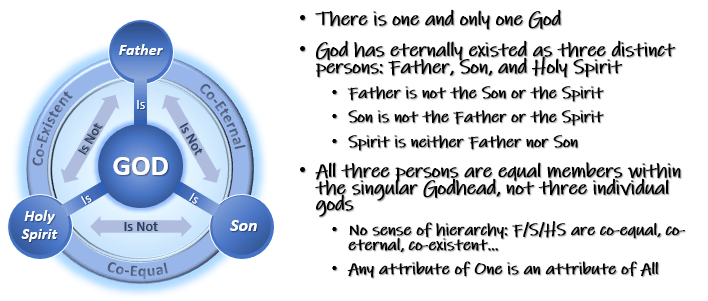
In short, whereas the doctrine of the Trinity declares the existence of “three persons within the Godhead” and looks something like this:

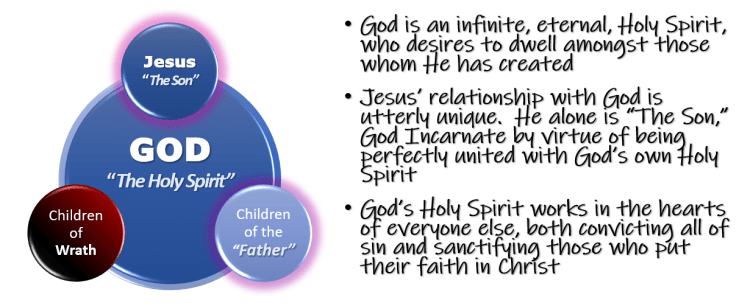
The alternative is much simpler and highlights the uniqueness of Jesus as God’s Son:

Not only is this alternative simpler to understand as well as apply, it also aligns much better with the entirety of Scripture than the Trinity. I know this is a bold claim, but as I’ve noted previously, the Trinity can’t point to a single verse of Scripture that unequivocally substantiates its core premise of “tri-personness in God.” Every aspect of the alternative, however, is clearly and unambiguously supported by dozens if not scores of passages, none of which require any special “rules,” “exceptions,” or “disclaimers” that the doctrine of the Trinity relies upon to keep from imploding when faced with passages that appear to refute it.

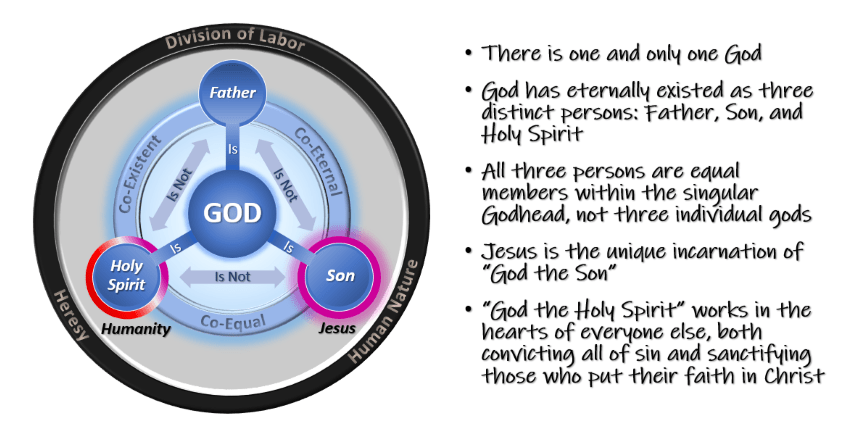
For example, there’s the constant appeal to Jesus’ humanity vs. His divinity as a way to preserve the equality of Father and Son… Then there’s this notion that a divine “division of labor” exists amongst the members of the Godhead, which helps to explain away any other apparent in-equalities between the Father, Son, and Spirit… And if all else fails, anything that contradicts or questions the veracity of the Trinity is simply dismissed as “heresy!”…

Indeed, when you think about the various “defenses” that the Trinity relies upon to survive, it is fair to say that they are as integral to the doctrine as its core premises. After all, without them, the doctrine becomes exposed to attack and hopelessly fragile. As such, a more complete picture of the Trinity would include an outer ring of its defenses:

And so, in this installment of the series, we’re going to put both of these frameworks to the test as we seek to apply both “lenses” to some enigmatic passages of Scripture and determine which framework illuminates…or at least coincides with…the obvious import of the passage.  Our goal is to truly let Scripture speak for itself rather than have the lens dictate the answer, but before forging ahead we need to give this alternative framework a name.

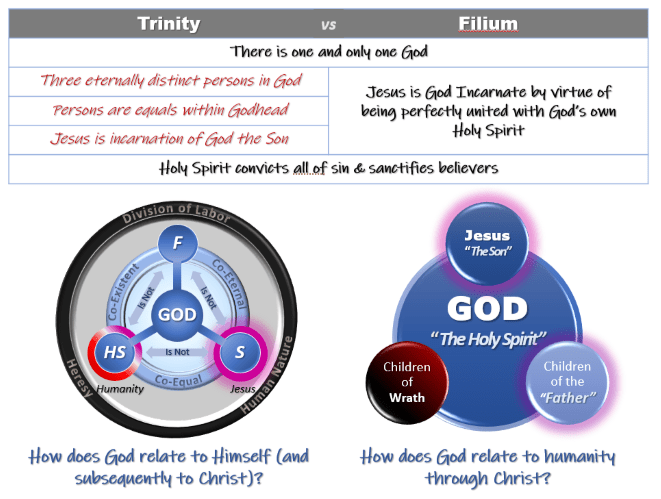
After many potential options I have settled on dubbing it the “Filium, ” a Latin word which translates to “The Son.” It’s an apt designation that focuses our attention upon Jesus as the foundation, pinnacle, and fullness of all of God’s plans.  Consider the diagram below, which compares the Trinity to the Filium:

Although each framework addresses a fundamentally different question, you’ll notice that there are actually two points of overlap between them…which incidentally are the only two stipulations of the Trinity that can be unequivocally substantiated with actual Scripture.  Moreover, notably absent from the Filium are all of the extra corollaries, conditions, and exceptions that the Trinity requires in order to maintain balance amongst members of the hypothetical “Godhead.”  They simply aren’t needed when God is in fact…One.  And most significantly, there is no need to worry about whether any given statement about Christ refers to the “fully God” divine Son or to the “fully man” person of Jesus – they are all about Jesus as the Incarnate Son of God. 

So without any further ado, let’s start with an “easy” question to get warmed up…

Why Does Jesus Pray?

Ever since I was a child learning about Jesus in Sunday school, the question of why Jesus prayed has always somewhat baffled me.  For in light of the fact that prayer is how we communicate with God, and since we affirm that Jesus is God, isn’t He effectively talking to Himself?  Furthermore, it always seemed odd to me that Jesus, as the Incarnate “second person,” couldn’t simply look within Himself to find the answers to each and every question rather than always appealing to the “first person.”  After all, as co-equal members of the “Godhead” (per the Trinity!) it’s not as if Jesus would ever get a different answer from the Son versus the Father.

Simply put, since the Trinity declares that Jesus is inseparably united with God the Son, would He not be able to draw upon that relationship to discern the will of God?  The short answer is “yes” in theory; however, the Trinity typically invokes its “division of labor” clause at this point, which stipulates that “God the Son” has a unique job description vis-à-vis both Father and Spirit.  In other words, the reason that Jesus prayed to the Father apparently has more to do with “divine protocol” rather than necessity.

That being the case, I eventually satisfied myself with the idea that even though Jesus didn’t technically need to pray to the Father, He did so primarily to teach His disciples the importance of devoting ourselves to prayer.  And while this explanation clearly makes some intuitive sense; unfortunately, it can’t account for everything.  Think about Jesus’ prayer in Gethsemane.  Jesus pleads with the Father for a way to avoid the horror that awaits Him, even though the Trinity declares that from all eternity the divine Son agreed that the Cross was the only way.  Accordingly, as the incarnation of the Son, what would be the point of this prayer? 

The Trinitarian response to this question predictably appeals to the distinction between Jesus’ human and divine natures, rightly positing that in His human nature there were indeed some limits on Jesus’ knowledge and understanding.  In practical terms, this means that in His humanity Jesus prayed to gain wisdom or to seek the will of God…just as we do.  And once again, while this answer provides a reasonable response to the question about Jesus’ prayer in Gethsemane, it also effectively brings us back to square one.  For since there is clearly more to Jesus’ prayer life than merely setting an example for the rest of us, tell me again why Jesus prays exclusively to the Father? 

In short, every answer inevitably leads to another question, and you soon find yourself going in circles just to explain the answer to the original question: if Jesus is God, why does He pray?  From the perspective of the Filium, though, I believe the answer is simple: as an Agent representing His Father, Jesus was obligated to seek out the will of His Principal…just as we are.  The difference is that as God Incarnate there was nothing inhibiting His connection; His complete and utter union with God’s Holy Spirit meant that He always knew exactly what He was supposed to do.  All He needed to do was ask.

“My food,” said Jesus, “is to do the will of him who sent me and to finish his work.”

John 4:34

Not only does this perspective align with all of the Scriptures that depict Jesus both asking for and carrying out the will of the Father, but it serves to instruct us as His disciples.  Because if Jesus’ entire life was a constant dialogue with God, such that by His example we learn what it means to “walk in the Spirit” or to be always “in the Spirit,” should we in any way assume that our need for prayer is somehow less vital than His?  Indeed, why do you think that Paul urges us to “pray without ceasing?” 

Thus when we consider the impetus behind Jesus’ prayers in general, or His agonizing plea in the Garden of Gethsemane specifically, it should both humble and inspire us to not take our relationship with God for granted.  For just as with Jesus, it is incumbent upon us to both seek out God’s will for our lives and then to respond as our Lord and Savior did to every request: “Thy will be done.”  Whether we’re talking about seeking God’s will in the “big things” or the seemingly small, passing moments, like Jesus our answer should always and ever be “yes, Father.”  Because whenever we say “no” to our Heavenly Father we pay lip service to our devotion and betray the same unholy spirit of sin and rebellion that plunged Adam and his descendants into ruin. 

More Questions Than Answers

While contemplating the rationale behind Jesus’ prayers is one thing, the passages that I found most cryptic when viewed through the lens of the Trinity are those where Jesus speaks of Himself in terms that clearly subordinate Him to the Father.  For whereas the Trinity is at least able to propose an answer to the question of why Jesus prayed – circular and nebulous as it may be – it is even more hard-pressed to explain statements like:

But of that day and hour no one knows, not even the angels of heaven, nor the Son, but the Father alone.

Matthew 24:36

How can there be things that the Father alone knows if the members of the Godhead are all co-equal?  Not surprisingly, the only answer that the Trinity can offer is to distinguish between Jesus’ human and divine natures.  Again, the problem is that since the Trinity is an “all or nothing” proposition, it has to somehow preserve the “co-equality” of the divine Son with both Father and Spirit in each and every circumstance.  Hence this appeal to Jesus’ human nature is the only real option, and quite frankly, most of the time this argument seemingly resolves the issue.

Nevertheless, the stark way in which Jesus singles out the knowledge of the “Father alone” certainly creates an added layer of complexity in this passage.  For since there are clearly things the Father knows that “no one” else is privy to, and since the Trinity would affirm that the divine Son and Holy Spirit are distinct persons from the Father, are they therefore included in “no one”?  The standard Trinitarian response to this question is an emphatic “of course not!” but I have also heard some appeals to the differing roles of Father, Son, and Spirit as a way to resolve the tension.  So which is it?  Because the latter option doesn’t seem very “co-equal” to me.

If this weren’t bad enough, the Trinity’s appeal to Jesus’ humanity in lieu of His deity completely falls apart in the face of verses that take things a step further:

You heard that I said to you, ‘I go away, and I will come to you.’ If you loved Me, you would have rejoiced because I go to the Father, for the Father is greater than I.

John 14:28

Here again, Trinitarians are quick to invoke the difference between Jesus’ human and divine natures.  In this case, though, if Jesus is truly referring just to His physical essence – which is really the only explanation that the Trinity can offer for the Father being greater than the Son – then the context of His entire statement immediately raises all kinds of thorny questions:

  • When Jesus says “I” go to the Father who is greater, if “I” is just His physical body, what becomes of His union with the “second person” when He leaves? 
  • How would it even be possible for Jesus to physically be with the Father apart from the “second person”?
  • Since the Trinity affirms that Jesus’ union with the “second person” is unbreakable – save for one moment on the Cross – then is it possible that Jesus is referring to the divine “Son” being somehow lesser than the “Father”?

There are very few options in the Trinity’s bag of tricks that even begin to make sense of these questions, and once again, every answer inevitably leads to another dilemma. Indeed, to the extent that you attempt to exclude either Jesus’ humanity or the “second person” from this passage, I think you’ll find that you’ve got even bigger problems to deal with…

In the final analysis, the only real argument that the Trinity can propose is that within the space of a single sentence, Jesus simultaneously uses the pronoun “I” to refer to His entire being (which will go to be with the Father) as well as His human nature exclusively (which is the only part of His being that is subordinate to the Father).  I don’t know about you, but this “answer” strains all sense of logic and reason. 

And what about the bizarre warning that Jesus gives to the scribes and Pharisees when they accuse Him of driving out demons by the prince of demons rather than by the power of God?  In Mark’s account, Jesus concludes His rebuke with a stern warning against blaspheming the Holy Spirit.  The Gospel of Luke, though, records the warning with an added caveat:

And everyone who speaks a word against the Son of Man, it will be forgiven him; but he who blasphemes against the Holy Spirit, it will not be forgiven him.

Luke 12:10

Although the Trinitarian response is predictable, it doesn’t really help when you try to reconcile it with the parallel doctrine which declares that “Son of Man” is a messianic title which should not be interpreted merely as a reference to Jesus’ human nature.  For whereas “Son of Man” appears to emphasize Jesus’ humanity from a certain perspective, its allusion to the heavenly figure of Daniel’s vision ostensibly makes it every bit as integral to Jesus’ deity as the title “Son of God.”  That being the case, how is it possible to blaspheme the “second member” of the Godhead with apparent impunity, and yet the same statements leveled at the “third member” would be unforgiveable?  Which doctrine has gotten it wrong? 

A Clearer Perspective

These are just a few of the many passages that the Trinity struggles to explain, and even with all of its caveats and defenses the answers are not forthcoming.  The problem is not the person of Jesus per se, but the need to preserve the full deity of a Son who is distinct from both Father and Spirit and yet simultaneously united with Christ.  This “triune” model may make sense in theory, but it just can’t stand up against the collective testimony of Scripture.  That being the case, these inconsistencies should give us pause and force us to reconsider our assumptions. 

Accordingly, let’s compare the Trinity’s “answers” to the conclusions that dovetail naturally with the Filium:

  • When Jesus says that the Father is greater than Him, there is no difficulty accepting that statement in light of the fact that as God’s Mashiach, Jesus is an Agent of the Father and therefore answerable to His Principal.  Indeed, Jesus is acknowledging that as “the Lord’s Christ” (Luke 2:26, 1 Cor. 3:23) His authority, His power, and His identity have all been given to Him by the Father via His own Holy Spirit.  So with the decisive battle for the Kingdom looming on the horizon, Jesus is simply letting his disciples know that He is being recalled to the Father’s side so that He can begin His next assignment: receiving the throne of His earthly Father, David, and ruling from Heaven in majesty and honor.
  • The fact that there are elements of God’s plan which Jesus has no direct knowledge of…at least not yet…reveals that from a human perspective He too had to live by faith in God’s promises even when He didn’t necessarily have all of the details.  This may seem strange to consider, but not only does this epitomize the human experience – and Jesus was fully human, after all – it certainly helps explain why Jesus’ prayer-life was so intense! 

Furthermore, think about Jesus’ faith in the context of Satan’s temptation in the wilderness: “If you are the Son of God…”  Remember how Satan lured Adam and Eve to disobey God by getting them to trust their own judgment rather than God’s Word?  Satan was likewise testing Jesus’ resolve to trust and obey His Father, and His unwavering obedience even unto death is the very model of Biblical faith.  Not only that, but the magnificent truth is that we can likewise prevail over temptation through the power of the very same Spirit that always gave Christ victory over the enemy!

  • Lastly, when it comes to Jesus’ admonition against blaspheming the Holy Spirit, the Filium sees this as a sober warning to His adversaries that as God’s Agent, they are in danger of not merely slandering Him but His Principal as well.  It harkens back to Isaiah’s warning whereby he proclaims “woe” upon those who intentionally try to obfuscate good and evil:

Woe to those who call evil good, and good evil; Who substitute darkness for light and light for darkness; Who substitute bitter for sweet and sweet for bitter!

Isaiah 5:20

Quite simply, Jesus is trying to get them to see how hardened and impervious their hearts have become to the Spirit of God.  Why else would they choose to ascribe the miracles done before their eyes to the power of Satan rather than God?  The tragic reality is that they would rather cling to their stubborn pride than yield to the prompting of the Spirit and glorify God, because in doing so they would also have no choice but to humble themselves and acknowledge the identity of the Son who is standing before them.  And so Jesus’ warning carries with it the gravest importance and eternal implications. 

Contrast this interpretation to the Trinity’s primary conclusion, which basically focuses on differentiating between actual blasphemy and the kind of mocking insults that Jesus apparently encountered on a regular basis:

They said to Him, “We were not born of fornication; we have one Father: God.”

John 8:41

Fair enough, but if Jesus is truly concerned about separating personal insults from statements that qualify as outright blasphemy, then why does He invoke the so-called “third person” in contrast to His humanity?  This would certainly be the opportune time to call out the “second person” if that was what He meant to say, but He didn’t.  So why put words into Jesus’ mouth?

In the final analysis, the Filium sees Jesus’ intentional juxtaposition of Son and Holy Spirit as further evidence of the fact that His identity as God’s Son is indeed through the Spirit.  He is plainly and forthrightly identifying the very source of His power and authority, not as some “third person” versus a “second person,” but as the fullness of the Spirit of God.  Thus not only is Jesus here to do the works of His Principal, but as with all duly appointed agents, an affront against God’s Agent is likewise an offense to the One who sent Him…plain and simple.

At this point I hope you are beginning to appreciate the needless complexity and confusion that are inescapable artifacts of the Trinity…especially in contrast to the simplicity and clarity of the Filium.  The “Human or Divine?” conundrum simply vanishes from the standpoint of the Filium, since it understands the Son to be God’s quintessential, human representative through the fullness of God’s own Spirit, rather than a participant in some hypothetical “triune Godhead.”  Consequently, since there is no need to try and discern if Jesus is talking about his “human” or “divine” nature, every statement is simply about Himself as God’s Messiah, the Father’s supreme Agent, who in spite of His power and authority is still subordinate and answerable to His Principal.